
Ultraviolet Light is a silent threat in the mountains. We spent plenty of our time and money trying to research the best baselayers, jackets, and hardgoods to help us conquer the mountains, but our eyes often get overshadowed. Actually in this case, they often get undershadowed: the snow of the alpine environment reflects the UV light in all directions and still plays an effect with standard sunglasses.
That’s where glacier glasses come in. These specialty glasses offer extra protection than standard glasses by blocking out the sides and usually offering less VLT (visible light transmission) than regular sunglasses. The result is less strain on the eyes, which means more time on the snow and rock, and a better chance of getting to places that nobody goes to.
I’ve been testing glacier glasses for nearly four years, sparked by an expedition to Mount Logan in the Yukon that woke me up to needing extra protection. I ended up using Gorilla Tape to protect the sides of my eyes, which sparked my journey toward looking for better options. The result is the four pairs of glacier glasses that you see below; each with something unique to offer, but all will protect better in the alpine landscape better than a regular pair of glasses. Read on to see how each pair fares out there.
The Best Glacier Glasses: Updated in 2026
Best All-Around Glacier Glasses: Smith Pursuit
Best Classic Style Glacier Glasses: Vallon Heron Glacier
Best New-School Glacier Glasses: Ombraz Refugio
Best Everyday-Use Glacier Glasses: Zeal Selkirk
Best All-Around Glacier Glasses: Smith Pursuit
Bottom Line: A wide field of view with removable side shields, and a photochromic lens that still works well when cloudy.
Weight: 50g (with strap and side shields)
VLT: 7-45%
Removable Shields: Yes
Extras: Nose guard, removable neck strap
Pros: Extremely versatile, interchangable lenses
Cons: Pricey, might be too big for many
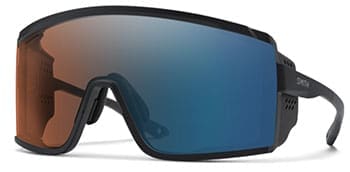
The wide field of view of these are as big as it gets, without feeling like a bit of a novelty. Wraparound glasses have become the norm in the backcountry, but the Smith Pursuit takes the volume to 11 with the add-ons of side shields, a nose guard, and a neck strap to keep them on when on the downhill or on the crux. It also has one of the best low-profile cases out there, which compresses when not used to save space.
The added bonus of being photochromic put these as our choice for all-around versatility. On top of that, you can even change the lenses if you have an idea of the weather and don’t want it shifting around too much. It certainly may be too big for smaller faces, but it’s pretty much the style these days. But if the goal is as much protection as possible, you really can’t go wrong with a pair that gives as much max value as this.
Best Classic Style Glacier Glasses: Vallon Heron Glacier
Bottom Line: A ton of protection in a small package.
Weight: 25g
VLT: 6%
Removable Shields: No
Extras: Leather case
Pros: Excellent protection, small surface area
Cons: Hard to put on with one hand due to the large ear loops
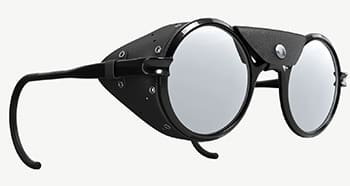
Vallon is a relatively new company out of Europe that has brought back the classic glacier glasses style in the best way possible—with safer materials. They have updated the arms to be made of TR90, a fancy polymer that will stand up in the elements. With ear loops that will ensure the glasses don’t come off, these felt the most snug of any glasses tested. The lenses are shatterproof, giving a modern update to a classic look. But beyond looks, the shades do their job of keeping light out. The leather side shields and removable nose piece ensured as little light as possible came into the eye socket.
Once they are on your face they will stay there. Since the VLT is so low, it’s not really great on days with variable weather. But in the bright sunshine, you’ll be hard pressed to find better protection that what Vallon’s Heron offers.
Best New-School Glacier Glasses: Ombraz Refugio
Bottom Line: Low profile that won’t fall off.
Weight: 27g
VLT: Not specified
Removable Shields: Yes
Extras: Case with sewn-in cleaning cloth, nose piece
Pros: Wide field of view, nearly impossible to fall off
Cons: Side shields and nose piece cost extra
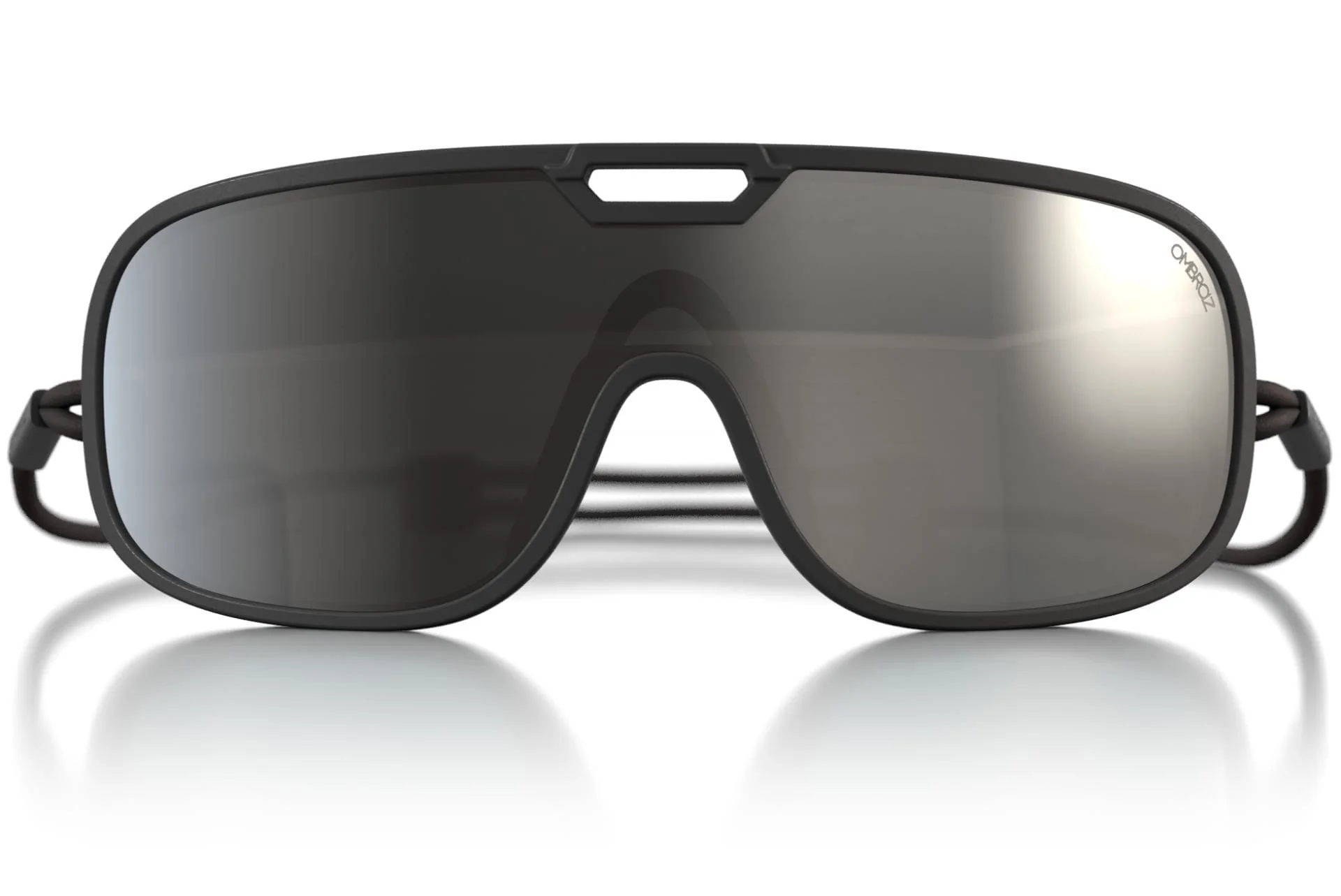
Sunglasses have a few disadvantages compared to goggles, especially when wearing a helmet. The straps of a helmet can squeeze the arms and make for sore temples. Ombraz has developed a whole new take on sunglasses by making them arm-free, opting for a thin piece of cord that wraps around the head. The result is a precise fit that would take a lot of effort to fall off one’s head if put on properly.
Some may dismiss the armless steeze as a gimmick, but I assure you it’s not. It keeps the sunglasses where they should be with hardly any wiggle room. Beyond that, the optics are absolutely excellent, designed and made in Italy using none other than Carl Zeiss optics. If you know that name, you know it’s a standard for quality.
The TP90 construction means they are also virtually indestructable and can protect your eyes in case of a crash. That’s not a challenge, though… but it’s good to know they are also good on the safety front as well.

Best Everyday-Use Glacier Glasses: Zeal Selkirk
Bottom Line: Comfortable fit that can be used in the valley as well
Weight: 27g
VLT: Varies (We tested Horizon Blue at 12%)
Removable Shields: Yes
Extras: Removable center piece
Pros: Polarized lenses, plant based resin
Cons: No nose protection
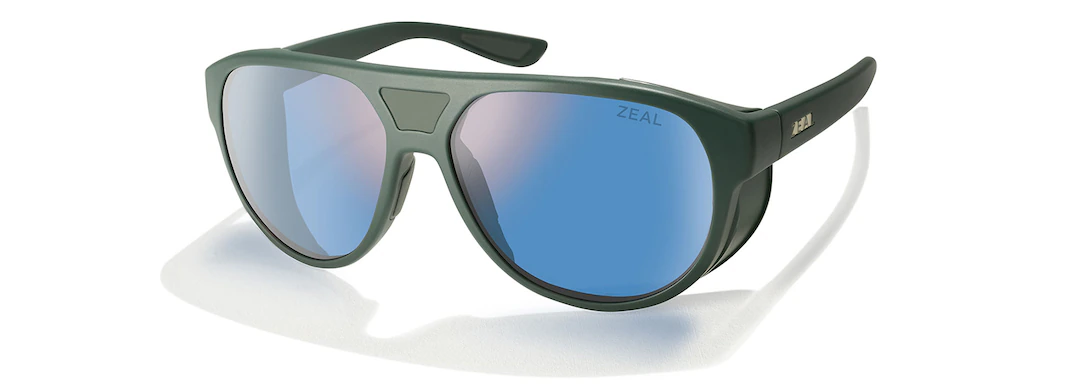
It’s no secret that we are fans of the Zeal Selkirk. They won the nod in our review of The Best Sunglasses For Backcountry Skiing and Splitboarding due to the versatility, style, and performance. Nothing has changed in that department.
Where these glasses outperform others is when off the mountain. They just look cool and get compliments all the time. So if you’re not one to have an unlimited budget to get a different pair of sunglasses for every single occasion, these might be the ideal choice for a pair you can wear anywhere, yet won’t sacrifice performance.
A bonus is that they are made with a plant-based resin, so any time less plastic is used, that’s a good thing. All in all, it’s a pair of shades that are both protective and stylish, not to mention environmentally friendly. Win-win-win.
How We Tested The Best Glacier Glasses
Testing glacier glasses takes a lot of time in the alpine environment, which thankfully is something that we here at Alpine Islands do well. Founder and lead educator Steve Andrews is a CAA avalanche educator and ski guide with the Canadian Ski Guide Association. Both roles require a lot of time in the mountains, on good days and bad.
Furthermore, I (Steve) am also a filmmaker. And like mentioned before, a month on Canada’s highest peak will showcase just how much good eye protection is needed. So from there, the search for the best glacier glasses came to fruition.
The criteria was pretty simple: Do the eyes feel ok after a day in the full sun, with snow reflecting the light at every which angle? So a non-scientific result of eye fatigue was (and should be) the number one criteria.
Other criteria involved weight. You don’t want glasses that will strain the bridge of the nose or fall off due to being heavy, or get displaced for the same reason. Equally (if not more) important is the safety factor. All of these glasses are tested to withstand impact, giving you an added layer of protection to your eyes beyond just UV light.
Then, as a secondary (but still very valid) criteria, the accessories that the glasses come with. Are the side shields removable? If so, how easy are they to remove? What kind of case does it come with? Can you change the lenses? All important questions, but didn’t really weigh into the main performance qualifications for the number one importance.
What to look for when buying glacier glasses
Glacier glasses are some of the most specialized sunglasses out there, because they have to block light from all directions. So here are a few questions to ask to help you find the perfect pair.
Fit: Do the glasses fit snug onto the face and stay put if shaking the head, looking down, or looking up?
Side Protection: Does light enter on the sides? If so, is it partially blocked, or do they fully block out?
Airflow/Fogging: Do the glasses provide enough airflow so that they don’t fog up? Any pair could fully block light but hopefully they don’t block air moving through and keeping the glasses dry.
Armbands: Do the armbands get in the way if using a helmet? Or are they like the Ombraz Refugio and use a pull cord? If your’e wearing a snug hat or helmet, will the armbands make your temples sore over time?
Lenses: Can you change the lenses? Are they photochromic, like the Smith Pursuit? Or are they static and block as much light as possible, like the Vallon Heron?
Materials: Are they reinforced to withstand impact? Are they plastic based, or bio-based, like the Zeal Selkirk? Will the lenses be shatter proof?
Price: Is the juice worth the squeeze? Can you afford it?
Service: How well does the company stand behind their product?
Answering these questions will help you narrow the search down much better along the journey to find the best pair of glacier glasses for you.
Final Thoughts
A good pair of glacier glasses are truly a game changer, and that’s coming from firsthand experience. There are many styles to choose from, but the important part is to have it in your pack when backcountry skiing, splitboarding, or mountaineering in the high alpine where light comes from all angles. Your eyes will thank you.