Alpine Islands is reader-supported. When you buy through links on this site, I may earn a small affiliate commission at no extra cost to you. We only recommend gear we’ve actually used, and a commission never buys a better review.
It’s hard to remember the world before headlamps were a ubiquitous part of the outdoor kit. I’m not talking about a bulky miner’s headlamp, but you know what I mean. If you are under 30 it may be surprising to think of a world before they were actually a thing. But I’m old enough to remember when flashlights were the norm, and you were cool if you had a mag light that was small enough to fit on a key chain. I also had one of those periscope flashlights that were the rage.
But then LEDs came around and changed the way we illuminate dark spaces. Now it’s tough to imagine the world without it. And the number of innovations out there have made it interesting to buy, but really most headlamps of the past 20 years follow the same recipe, with an elastic strap and a battery powered unit in front.
That recipe is fine right up until you start moving fast. Trail running in the dark is where a standard headlamp shows its limits: the strap loosens, the battery box bounces, and you end up reaching up to reset it every few minutes instead of watching your footing. That’s what sent me open to something built differently.
Now that I’ve tried the Knog Bandicoot 250, I’ve seen a whole new design, and one that makes sense for people who move fast. It works well, stays on the head, and survives the elements. Sounds cool, right? It’s also easily rechargeable with USB.
Knog Bandicoot 250: First Impressions
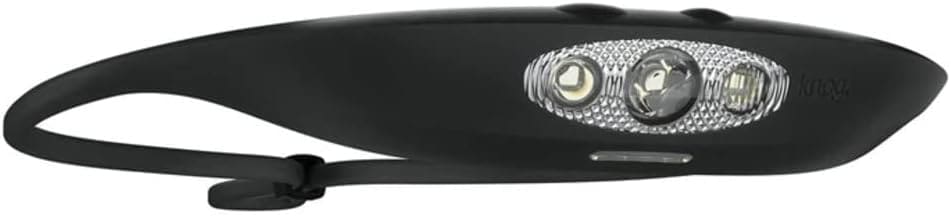
The Bandicoot doesn’t look like any headlamp I’d worn before. It’s a single unit. There’s no elastic band, no battery box, just one continuous piece of soft silicone with the light built into the front. The adjustment is easy to dial in and sits more flush on the forehead than others, which is nice to have a headlamp be slim to the face. But moving is where I really noticed the difference.
Bottom Line: A one-piece silicone headlamp that stays put when you’re moving fast, with USB-only charging as the trade-off.
Max Output: 250 lumens
Weight: 60 g (2.1 oz)
Beam Distance: Up to 40 m (130 ft)
Modes: Combo, Spot, Ambient, Red, Reading — four brightness levels each
Runtime: 8–28 hrs (Combo) to 32–105 hrs (Reading)
Charging: Integrated USB-A plug, 4-hour charge
Water Rating: IP67 (1 m)
Strap: Transparent medical-grade silicone, fits 30–66 cm
Warranty: 2 years
Price: ~$49.99 USD
Pros: Stays put at speed, no separate cable needed, IP67 rated, five modes
Cons: USB-only — no spare batteries, exposed plug is a wear point
Notable Features of the Knog Bandicoot 250
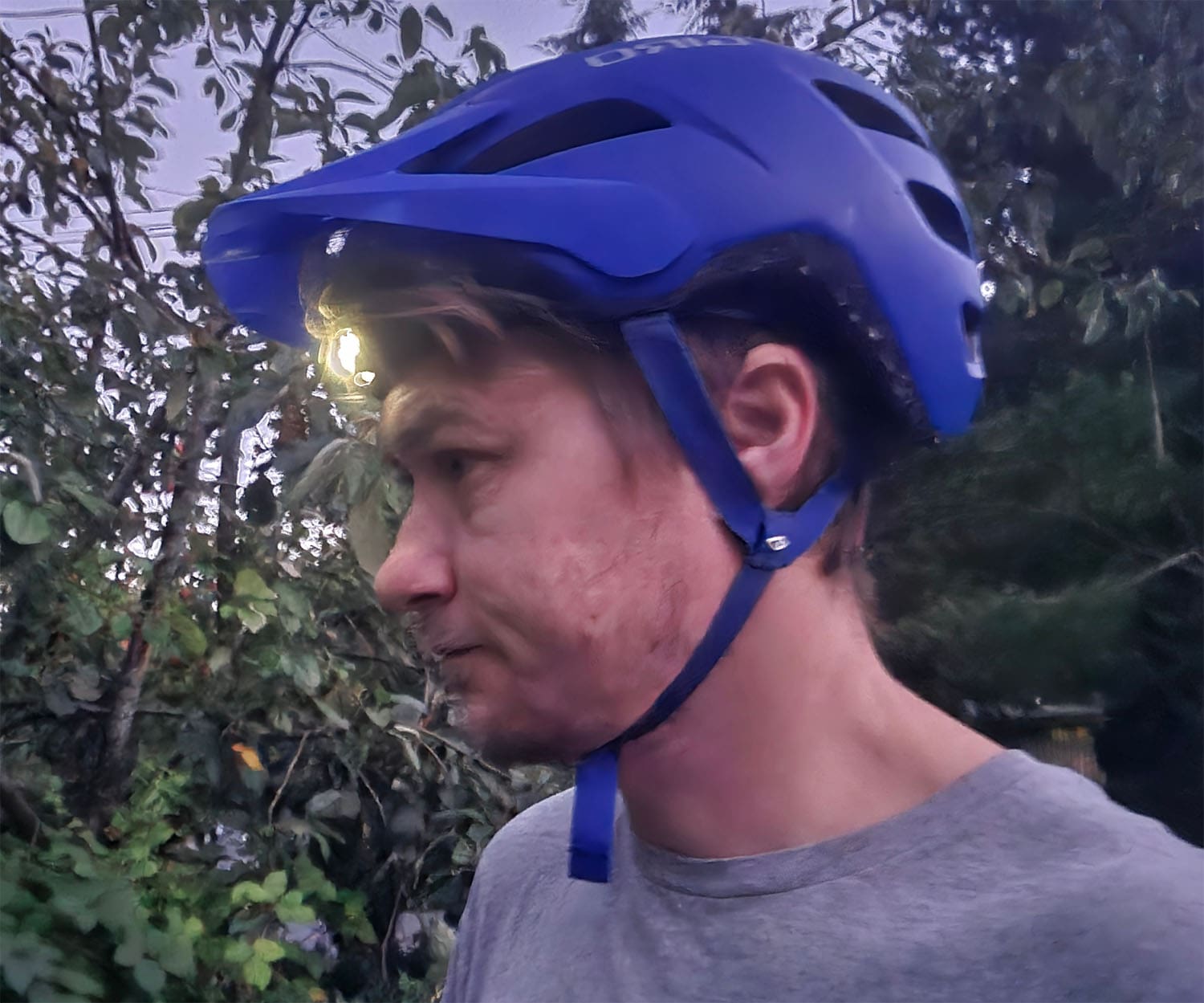
One-piece silicone band: Instead of an elastic strap threaded through a plastic housing, the whole headlamp is a single loop of transparent medical-grade silicone with the light moulded into the front. Knog rates the fit range at 30–66 cm, adjusted by a toggle, so it goes on bare heads, over toques, and around helmets.
Integrated USB-A plug: The light pod itself folds out into a USB-A connector, so there’s no cable and no port cover to lose. A full charge takes about four hours.
Five modes, four brightness levels each: Combo runs at 250 lumens for 8–28 hours, Spot at 200 lumens for 12–36 hours, Ambient at 50 lumens for 22–70 hours, plus a 4-lumen red mode and a 6-lumen reading mode that stretches to 105 hours. Beam distance tops out around 40 m.
IP67 sealing: Rated for full submersion to one metre and an operating range of -20°C to 50°C, which covers a coastal BC winter without much drama.
Programmable via app: Knog’s Modemaker app lets you reassign which modes are in the rotation, so you can strip it down to the two or three you actually use. There’s also a lock mode and a battery indicator.
Drawbacks
Since it’s USB only, you can’t just bust out a spare pair of batteries if it runs out of juice. You need to have a charger with you, which might piss off some of the ultralight crew. But recharging requires a power source regardless.
The other one worth naming is the plug itself. Because the USB-A connector is part of the light and gets flexed out every time you charge it, it’s a moving part on a lamp that otherwise has almost none — and if it gets damaged, there’s no workaround.
Best Uses for the Knog Bandicoot 250
If you have a small solar unit, you’d be happy recharging this pretty easily. Same goes for a small power bank that isn’t too cumbersome. But the people loving this one are people who run and move quickly in all directions, where a traditional headlamp might get shaken loose. This stayed put no matter how fast I was bobbing and weaving in the trails.
Skip If You…
You are out on the trail for a long time and prefer just using spare batteries. This charges by USB so you need a USB charger with you. It’s also not great for people who are super hard on their gear, because if the USB gets damaged while you’re taking it in and out to charge, you’re going to be out of luck for power.
Final Thoughts
Most headlamps have been iterating on the same recipe for two decades, and the Bandicoot is the first one in a while that made me rethink the recipe itself. A single loop of silicone, a light moulded into the front, a plug that folds out of the body… it’s less headlamp-with-features and more headlamp-rethought. For anyone moving fast in the dark, that matters more than another 50 lumens would.
The USB-only charging is a real limitation and worth thinking through before you buy, especially on longer trips away from a power source. But if you’re within reach of a power bank or a small solar panel, it’s a trade I’d make for a light that doesn’t budge.
Frequently Asked Questions
Is the Knog Bandicoot 250 waterproof?
Yes. Knog rates it IP67, which means it’s sealed against dust and can handle full submersion in one metre of water. Rain, spindrift, and a dunk in a creek crossing are all well within what it’s built for.
How long does the Knog Bandicoot 250 last on a charge?
It depends entirely on the mode. Knog rates Combo mode at 250 lumens for 8 to 28 hours, Spot at 200 lumens for 12 to 36 hours, and Ambient at 50 lumens for 22 to 70 hours. The low-output red and reading modes stretch out to 72 and 105 hours respectively.
How do you charge the Knog Bandicoot 250?
The light pod folds out into a USB-A plug that goes straight into a port — no cable required. A full charge takes about four hours, and there’s a battery indicator so you know where you stand before heading out.

Steve Andrews is a lifelong adventurer since before he could walk. A skier since age 2, snowboarder since 11, he began his guiding career in 2007. He has a passion for teaching people how to fish, and helping them discover their own power in the mountians. He started Alpine Islands to give people a different take on achieving mastery in the wild (hint: you’re never a master of Mother Nature). He lives in Horseshoe Bay, British Columbia with his partner and two kids.