Of all the dangers that come from backcountry skiing or splitboarding, an avalanche is one of the most predictable. We take courses, we obsess over the forecast, and aside from a pesky persistant weak layer, we’ve got it more or less down to a science.
But dangers persist far more than a weak layer in the snowpack. Of all the ways to get in trouble, be it a change in the weather, an injury, wildlife, dead battery, etc., the biggest of hazard of all, I would argue, is human ego.
Ego served us well while we evolved. Its essentially our sense of self and how we distinguish ourselves within our social circles. Back in the day, being cast out of the group pretty much guaranteed one’s death, so we had an imperative to fit in and do our best to place ourselves high in the pecking order.
But that need to look capable and belong is a survival instinct. But in the framework of decision making in the backcountry, it’s pointed at the wrong target. In the mountains, protecting one’s reputation can increase risk exposure if people have certain expectations, especially if their experience level is to a point they have not been personally exposed to a potentally fatal, low-probability/high-consequence outcome.
Defining the Human Factors
In 2004 Ian McCammon created a framework outlining six heuristic traps we encounter when making decisions in the backcountry. The acronym FACETS is now taught in avalanche courses to help people be more aware of non-environmental factors that we humans face. They are outlined as:
- Familiarity: The trap of thinking you know an area so well that you can assume how the conditions are because you’ve been there dozens/hundreds of times. Interestingly enough, the research shows that the higher the experience level, the riskier decisions the participant will tend to make.
- Acceptance: Group members will tend to make riskier decisions if they believe that act will help them get approval from the rest of the group. Social media has only made this trend worse.
- Consistency: People (especially in larger groups) will stick to a bad plan if they had a predefined goal that they don’t want to turn around on. Also known as “summit fever”, people will ignore warning signs if their objective is predefined and unwavering.
- Expert Halo: Most parties will have a leader with more experience, or is a professional/client dynamic. A Novice will more likely follow someone with more experience into danger more often than if a group of novices went out together. The power dynamic also makes those with less experience afraid to speak up if the more senior’s plan bears risk.
- Tracks/Scarcity: A party will take more risks if they feel the pressure to ski a fresh slope, thinking it’ll be tracked out by the next day if they wait.
- Social Facilitation: If a group sees another group in the backcountry, they are more likely to take risks than if they were all alone. It’s the mindset of “well they are doing it, so it must be okay”, despite not knowing the other parties’ education or skill level. This is more pronounced in more expert groups, as their risk exposure is generally already higher as a baseline.

So it has now been 22 years (and counting) since McCammon’s paper went out and a whole new generation of people have been trained to recognize it. But people still get into precarious situations all the time.
So the question is, can we find a way to temper that deep-rooted desire to impress our peers (whether conscious or unconscious), by changing the whole mindset altogether? If so, can we then build a process to help one stay in that anti-egoic mindset and hopefully make better decisions from a more balanced mindset?
Practicing Shoshin
Shoshin (初心) is a Zen buddhist concept that essentially means The Beginners Mind. It’s a potentially life-changing worldview in not only backcountry recreation but nearly all aspects of growth and development along the human experience.
Anyone with children in their lives likely marvels at some of the wisdom that comes out of their mouths by providing a completely new take on a well-worn concept. Our minds are prone to conditioning, and an environment as dynamic as the backcountry, this can get us into trouble.
But by treating each new experience as though it was our first, our senses become more attuned to the subtle clues that may clue us in that something is amiss. It also helps us not skip steps by making assumptions, and helping us to see each situation for what it is: unique in its own way.
So I encourage you to take the practice of Shoshin into each day while out in the backcountry and not rely on experience or expertise to make the decisions. It may take longer, but the odds of you detecting something you’d otherwise not be attuned to could save lives.
Planning and Open Communication: The Antidote to Egoic Decisions
It’s foolish to say that we can eradicate our ego in life. We all have egos and to deny them would be a dangerous and ignorant exercise. But, through a bit of work (which gets easier the more you do it), you can keep the ego in better check and prevent situations where it takes over in the moment. The two main tools I have found is: setting a good plan and sticking to it, and allowing for constant, open, and judgment-free communication within the group.
The first takes some repetition, as well as documentation to really make it stick. As I’ve gotten older I’ve discovered the power of putting things in writing for both personal and professional life. In the context of ski touring and splitboarding, it means documenting not only an objective, but a turnaround time, risk tolerance, the avalanche forecast, and fitness levels.
It sounds like it may be a buzzkill but it actually leads to a much smoother time out with your crew. When all the things that go unsaid are aired out before any friction arises, you have the ability to preempt an uneasy discussion by already knowing someone’s baseline. Problems occur when people aren’t on the same page and they make assumptions about one another.
The second tool, judgment-free communication, is a tough one, and also takes practice. I also acknowledge how, as a white male, that it might be a whole lot easier for me to feel safe openly communicating without fear of judgment than someone coming from a more marginalized background. But that’s where it’s really a good idea to know how people communicate, and not take anyone’s bullshit. This is true in all of life, but especially true in the backcountry.
A Free Tool To Help Build The Habit
Not being one to just sit idly by and wish things could be better, I have a gift for you for reading this far. It’s a simple tool based on what we have discussed to help you plan out the day, get it in writing, and communicate it with your crew.
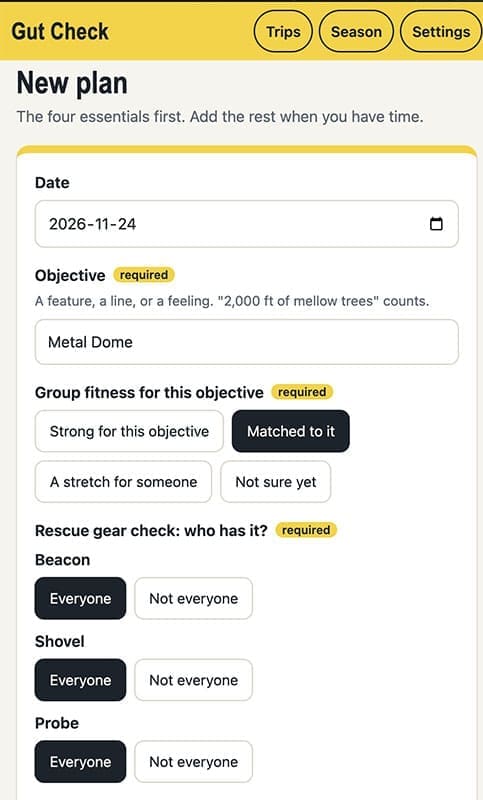
What really makes this app different from others is that there’s a debrief component, so you can see how well you stick to the plan. That in itself isn’t a big revelation, but what does make it powerful is when you add it up over a season. If you find that you’re departing from the plan in a certain area, then maybe there’s a blind spot in the way you are treating a situation that could lead to trouble.
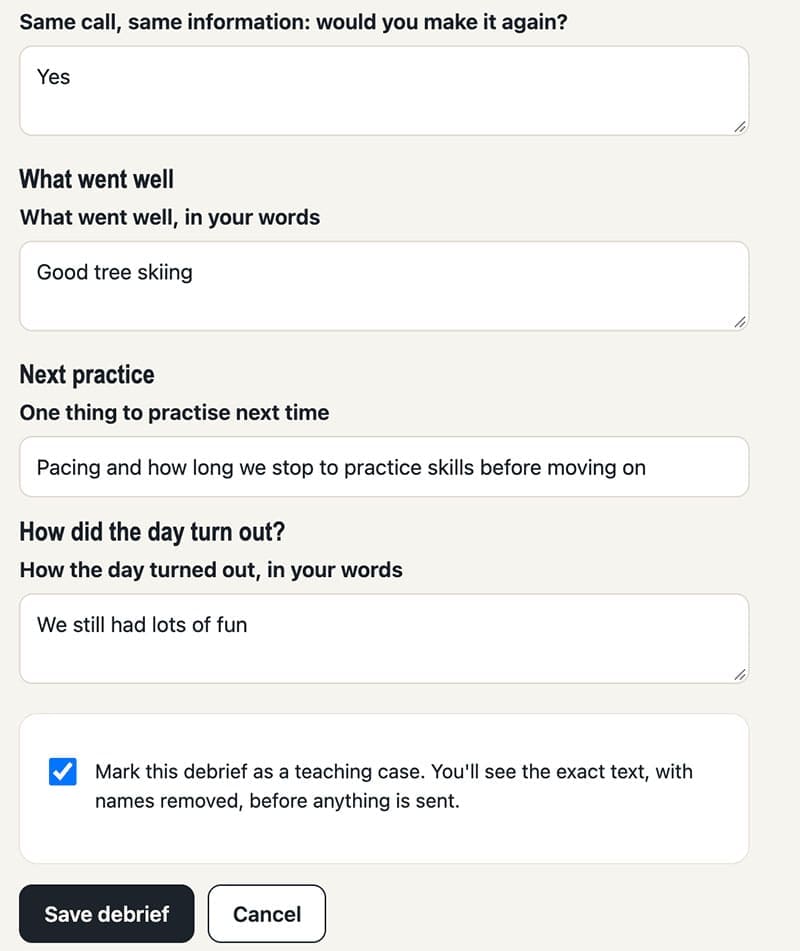
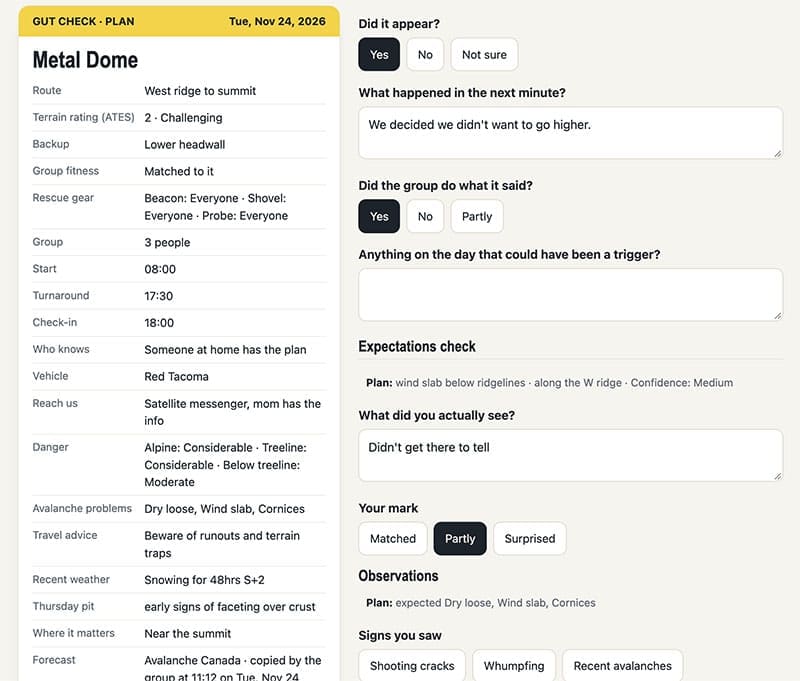
It also gives the option to (anonymously) share the results to help us teach others, and hopefully keep evolving as both individuals and as a group.
All you need is an email address and you’re in. Remember that the goal is consistency over time, just like all we do here at Alpine Islands, so the more you use it, the better it will clear the gap between your plans and how you execute on them in the backcountry.
If this type of content is useful, consider joining our community to connect with others. We have many other resources to help you get a better sense of your surroundings. Try the Pattern Reader to learn weather patterns that can cause trouble. We also have an app for building snow profiles and offer regular check-ins through the Mountain Dojo by moving up in the Belt system. Wishing you many days full of fun, challenge, growth, and safety.

Steve Andrews is a lifelong adventurer since before he could walk. A skier since age 2, snowboarder since 11, he began his guiding career in 2007. He has a passion for teaching people how to fish, and helping them discover their own power in the mountians. He started Alpine Islands to give people a different take on achieving mastery in the wild (hint: you’re never a master of Mother Nature). He lives in Horseshoe Bay, British Columbia with his partner and two kids.