Alpine Islands is reader-supported. When you buy through links on this site, we may earn a small commission at no extra cost to you. We only recommend gear we’ve actually used, and no brand pays for placement or a favourable review.
It took me a long time to get in the habit of using a radio while in the mountains. As someone who grew up exploring year round in the Pacific Northwest, getting lost was a feature of the activity, not a bug. But as I grew older, became a guide, and then a father, I realized that seconds can count when something goes wrong, and having a buddy or partner to communicate effortlessly with is non-negotiable.
A few years back, I reviewed some radios for other publications, and now I’ve got a good grip on what’s available in the consumer walkie-talkie space. I now take them everywhere, much to the dismay of some of my compadres for overuse. But it’s fun. And safe. And actually improves the day with better communication, as long as the privilege takes some responsibility with it.
Of all the radios I tested, The Rocky Talkie Mountain Radio won for the sheer ease of use, bombproof (not literally, silly) durability, water/snow proofing, and lightweight package. That’s a lot of pluses, and I couldn’t find too many negatives.
I’ve had these radios for just over a year and have taken them snowboarding, paddleboarding, mountain biking, hiking, camping with the kiddos, and on film shoots. They join me pretty much anywhere that I need to get gnarly and would like a simple and easy way of reaching people. It’s even better than a cell phone for how quick you can communicate and not need to do more than just push a button and talk. Read on to see what else is great about these.
Rocky Talkie Mountain Radio: First Impressions
The very first thing I noticed about these radios is how light they are. They are also compact, and clipping it onto my backpack strap was pretty negligible in any change it felt. Communication was clear and effortless, and only started to drop out at the 1 mile mark with terrain in between, and probably closer to 5 miles with a clear line of sight.
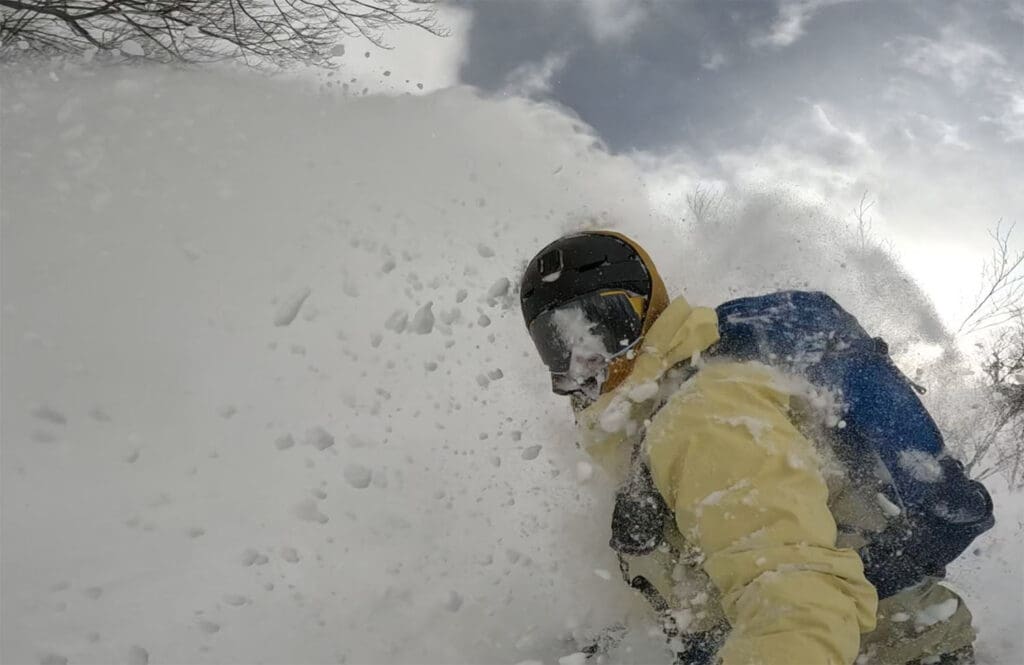
I have been riding with these radios on my pack and getting blasted with snow is no worry. It’s been dry snow, but as the rating says, it can get a good dose of snow without being too much of an issue.
I do take it paddleboarding, but I clip it to the top of a large rig. I’d be a bit nervous if it were on something that could tip or get submerged, but for floating missions it’s not an issue.
Bottom Line: A licence-free radio simple enough to hand to anyone, tough enough to stop thinking about, and light enough that it actually comes along.
Weight: 6.1 oz / 173 g (radio only)
Dimensions: 9.3 x 6.3 x 2.8 cm
Radio Service: FRS, 2 watts, no licence required
Range: 1–5 miles in mountains
Channels: 128, with 121 privacy codes
Battery: 1550 mAh Li-ion, 3–5 days, USB-C, user-replaceable
Waterproofing: IP56 (splash and snow, not submersible)
Attachment: Trango Quantum climbing-rated carabiner + metal-reinforced leash
Warranty: 3 years personal use / 1 year commercial
Price: ~$110 USD per radio, ~$220 USD for the two-radio kit
Pros: Dead simple to operate with gloves on, genuine climbing-rated attachment, excellent cold-weather battery life
Cons: Splashproof but not submersible, sold per unit so a usable pair is double the sticker price
Notable Features of the Rocky Talkie Mountain Radio
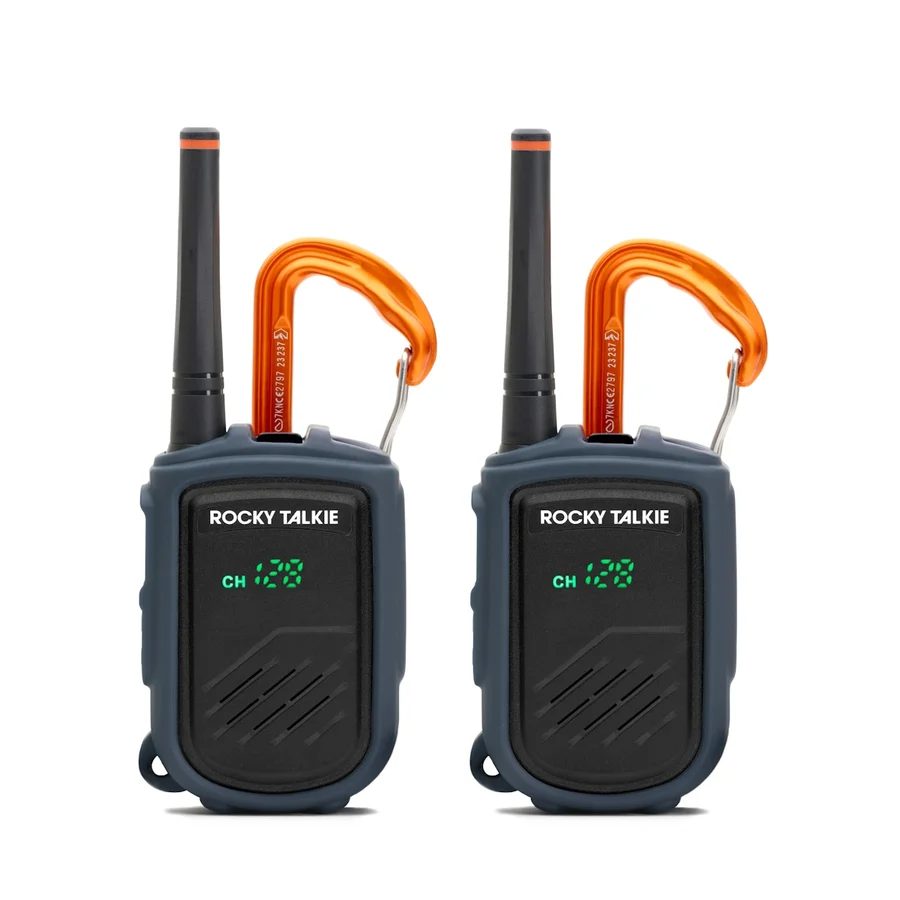
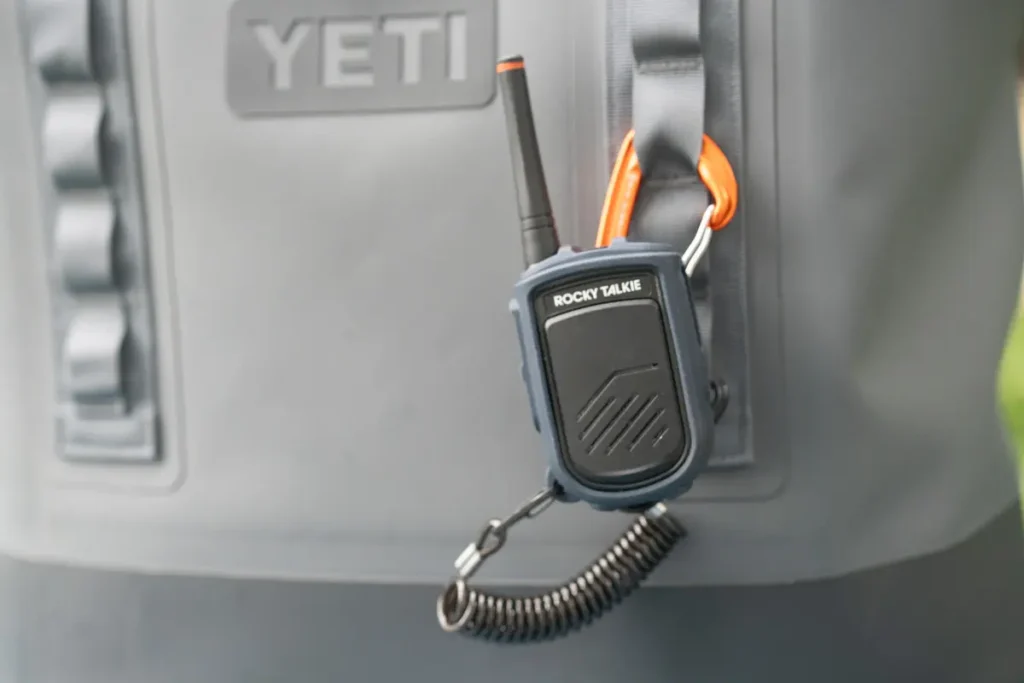
An attachment system that isn’t an afterthought: Instead of the brittle plastic belt clip that comes on most consumer radios, the Mountain Radio ships with an ultralight climbing-rated carabiner and a metal-reinforced backup leash. It clips to a harness gear loop or a shoulder strap and stays there.
Five buttons and zero setup: The radio works out of the box with no configuration. There’s a channel lock so you don’t bump yourself onto channel 47 mid-descent, and the controls are sized to be worked with gloves on.
A battery built for cold: The 1550 mAh lithium-ion pack is rated for 3–5 days on a charge, and Rocky Talkie specifically rates that figure for extreme cold — which is the number that actually matters in February. It charges over USB-C, making it easy to pair with a small power pack back at basecamp.
Maximum legal power without a licence: It transmits at 2 watts, the ceiling for licence-free FRS use. The honest number for real terrain is 1–5 miles in the mountains and 0.5–3 miles in forest and hills.
Parts you can replace instead of a radio you throw away: The screen is shatterproof, the body is wrapped in thermoplastic, and the battery, case, and leash are all sold separately as replacements. Backed by a three-year warranty for personal use, it’s refreshing to see a company standing by their product. Especially for something that is meant to be abused.
Drawbacks
It’s splashproof, not submersible. The IP56 rating covers rain, spray, and snow, but not dunking. That distinction matters more on the water than it does on snow, and it’s the one spec I’d want anyone paddling with these to understand before they clip one to a PFD.
A single radio is a paperweight. At roughly $110 USD each, the real cost of entry is the two-radio kit at around $220 USD.
Two watts is two watts. FRS caps transmit power, so no radio in this class will punch through a ridge. If you need more reach or want to talk to a licensed network, that’s a different tool. Rocky Talkie’s own Expedition radio runs 5 watts on GMRS.
North America only. Rocky Talkie sells the Mountain Radio for use in the United States and Canada. FRS frequency allocations differ elsewhere, so it’s not a radio to pack for a trip abroad. And don’t risk taking it to Japan, where FRS radios have been known to be confiscated at some of the busier resorts.
Channels can change easily if not locked. Yes, you can lock onto the channel you’re using, but sometimes you forget, and you won’t know you did until your friend starts panicking because they can’t get in touch, or the other way around. Not a total defect, but a habit you’ll have to get used to doing on the regular.
Best Uses for the Rocky Talkie Mountain Radio
This is a group-coordination tool, not an emergency beacon. It earns its place any time you’re splitting up and want to close the gap back down fast: snowboarding and riding lifts with people who ski at different speeds, mountain biking a shuttle lap, keeping tabs on kids at a campsite, or running a film crew where “push button, talk” beats waving your arms across a clearing. It’s also the radio I’d hand to someone who has never used one, because there’s nothing to explain.
It’s my new snowboarding pal. With the easy clip-on access to a backpack strap (or the optional attachment to keep it safely in your pack), this makes communication with the crew easy. You can scout lines and tell buddy where to find the goods, or line up a shot and send it. Even if you’re in cell range, it’s still light-years faster than pulling out the phone, looking up a contact, and sending. I can literally blast out the group within a few seconds with the gloves still on.
Skip If You…
Need a serious communication tool where lives are on the line. The acronym FRS says it all: Family Radio Service. This is for the crew, not for big rescue missions. But you probably already know that if you are someone who is doing this professionally. But for close range and easy use, these radios are the best consumer walkie talkie by a long shot.
Final Thoughts
The Rocky Talkie Mountain Radios are a simple tool, and not a professional radio by any means. It’s a bit pricier than your average walkie, but the features that make it better such as the lightweight, and shockproof/splashproof case are well worth it. The battery lasts plenty long, and endures the cold without worry. I’ve taken it to the beach, and top of a mountain and had no issues at all. Communication is clear, and I can’t really say anything bad about it. Honestly. They’ve built a well-functioning, easy to use radio that could be life-saving if you’re in a pinch out in the mountains. Take this as an enthusiastic two-thumbs-up for a review.
Thanks for reading! Please check out more Gear Reviews, or learn about what sets Alpine Islands apart. If you want to know more, please get in touch. We are stoked to have you as a part of the community.

Steve Andrews is a lifelong adventurer since before he could walk. A skier since age 2, snowboarder since 11, he began his guiding career in 2007. He has a passion for teaching people how to fish, and helping them discover their own power in the mountians. He started Alpine Islands to give people a different take on achieving mastery in the wild (hint: you’re never a master of Mother Nature). He lives in Horseshoe Bay, British Columbia with his partner and two kids.