Written by
Steve Andrews
Credentials
CAA Basic Avalanche Educator · CSGA Ski Guide
Based in
Sea to Sky, BC
Picks referenced
8, from my baselayer roundup
Updated
November 2026
In this guide
- The short version
- What a baselayer does
- Materials compared
- Baselayer picker
- Weight & warmth
- Reading the label
- Fit & construction
- Warranty & longevity
- Care & repair
- Sustainability
- FAQ
- The final word
This page uses affiliate links to help pay the bills. We only recommend products we’ve tested in the field and actually enjoy. Read our Gear Review Policy for more info.
Every winter someone asks me which baselayer to buy, and the honest answer is always the same: it depends on how hard you’re working and how cold it is. The labels don’t make it easy. One brand calls it a 200, another a Midweight, a third a Thermal Max, and none of them tell you what any of it means on a cold chairlift.
This guide is the long version of the “How to Choose” section in my best baselayers for snowboarding and skiing page. It covers what the numbers on the tag mean, how the fibres actually behave, what the warranties really cover, and how to make a baselayer last. The goal is simple: you should be able to walk into a shop, read a label, and know whether that layer fits your day.
We even developed an easy-to-use baselayer picker to help you narrow down the effort based on your needs.
The Short Version
If you’re just getting started, one good midweight merino top covers most days at the resort and plenty in the backcountry. Add a lighter layer if you start touring and sweating on the skin track, and a heavier one if you run cold or ski a lot of deep-freeze days. That’s the whole kit for most people. Everything below is how to choose each one well.
What a Baselayer Actually Does
A baselayer’s main job is less about warmth, and more about moisture management. Heat comes from layering. Your body pushes out sweat and water vapour all day, even standing still, and whatever fabric sits against your skin decides where that moisture goes.
That matters because water moves heat away from your body far faster than air does. Its thermal conductivity is more than 20 times higher, so a damp layer against your skin pulls warmth out of you on every lift ride after a hard run. Anyone who has made the mistake of wearing cotton and sweating in the cold probably learned this the hard way. A good baselayer moves moisture off the skin and lets it escape through your midlayer and shell.
Baselayer Materials Compared

Here’s how the common baselayer fibers stack up. These are general tendencies, not lab results. Knit, weight, and blend can move any material up or down a row.
| Material | Warm when damp | Breathability | Odour resistance | Dry time | Durability | Itch risk |
|---|---|---|---|---|---|---|
| Merino wool | Good | Excellent | Excellent | Moderate | Fair (better with a nylon core) | Low |
| Alpaca | Good | Very good | Excellent | Moderate | Fair to good | Very low |
| Plant-fibre blends (lyocell / TENCEL™) | Fair | Very good | Good | Moderate | Fair | None |
| Synthetic (polyester, polypropylene) | Fair | Good | Poor | Fast | Excellent | None |
| Silk | Fair | Good | Fair | Fast | Poor | None |
| Cotton | Very poor | Good when dry | Poor | Very slow | Good | None |
Ratings are my general read on each fibre, not manufacturer data.
Merino Wool
Merino is the benchmark for a reason. The fiber absorbs a good share of its own weight in moisture vapour before it feels wet, it keeps insulating when damp, and it resists odour well enough that a merino top can go days between washes. It even gives off a small amount of heat as it absorbs moisture. The trade-offs are price and durability. Pure merino is softer but wears through faster, which is why many brands blend in a bit of nylon or elastane. My heavy pick, the Smartwool Intraknit Thermal Max, is a 97% merino blend, and the Icebreaker 200 Oasis is 100% merino.
Alpaca
Alpaca fiber is partly hollow, which traps air and makes it feel warm for its weight. It contains no lanolin, so it’s a good option for people who find even fine wool scratchy. It tends to feel a touch bulkier than merino. The Arms of Andes Alpaca Half Zip is pure alpaca, while the PAKA Thermal Crew blends alpaca with merino and TENCEL™.
Plant-Fiber Blends (Lyocell / TENCEL™)
Lyocell is a regenerated cellulose fibre made from wood pulp. It isn’t a natural fibre in the way wool is, but it is plant-based rather than petroleum-based. On its own it isn’t very warm. Blended with wool, it adds a cool, smooth feel and helps move moisture, which makes it good for people who run hot. The Mammut Tree Wool Thermal FL Tights are my pick here.
Synthetics (Polyester, Polypropylene)
Synthetics dry fastest and last longest, and they’re usually cheaper. The downsides are odour, since bacteria love polyester, and microplastics: synthetic fabrics shed tiny fibers every time they’re washed. Brands add odour treatments and smarter knits to close the gap. The Patagonia Capilene Midweight and the Arc’teryx Rho SV are the synthetics I’d still reach for, especially for hot spring days when a baselayer may be your only layer.
Silk
Silk is light, smooth, and packs down to nothing. It also isn’t very warm or very tough, so it works best as a thin liner under another layer rather than as your main baselayer.
Cotton
Skip it. In fact, turn any baselayer into a rag to dry your board off before bringing it inside. Cotton soaks up sweat, holds it against your skin, and takes forever to dry. That’s exactly how you end up shivering on the chairlift after a hard run. The old outdoor saying “cotton kills” is common for a reason.
Baselayer Picker
Not sure where you land? Slide in how hard you’ll be working and how cold it’ll be, and the picker below suggests a material and weight to start from. It’s a starting point, not a verdict.
Choose The Best Baselayer for You
The suggestion updates as you go.
This is just a starting point to lessen overwhelm on decisions. Everyone is different. Hopefully this helps you out a bit.
Weight & Warmth
Baselayer weight is usually given in GSM, grams per square metre of fabric. More grams means more fiber, more trapped air, and generally more warmth. Brands use the number differently, though. Some put it right in the product name (Icebreaker’s 200 Oasis is a 200 GSM fabric), others use words like Lightweight, Midweight, and Thermal. When in doubt, check the spec sheet for the actual GSM.
| Weight class | Typical GSM | Best for | Examples from my roundup |
|---|---|---|---|
| Lightweight | 150–200 | High output: ski touring, skinning, spring days | Icebreaker 200 Oasis, Mammut Tree Wool Tights |
| Midweight | 200–260 | All-round resort and backcountry days | Patagonia Capilene Midweight, Arc’teryx Rho SV (210) |
| Heavyweight | 260 and up | Cold days, low output, lots of standing around | Arms of Andes Alpaca 300, Smartwool Intraknit Thermal Max |
GSM isn’t the whole story. A 200 GSM grid fleece can feel warmer than a 250 GSM flat top because the grid traps more air. That’s why the knit matters too, which brings us to the label.
Reading the Label
People sometimes ask about thread count when they shop for baselayers. Thread count describes woven fabrics like bedsheets; baselayers are knits, so it doesn’t apply. These are the numbers and words on the label that do tell you something.
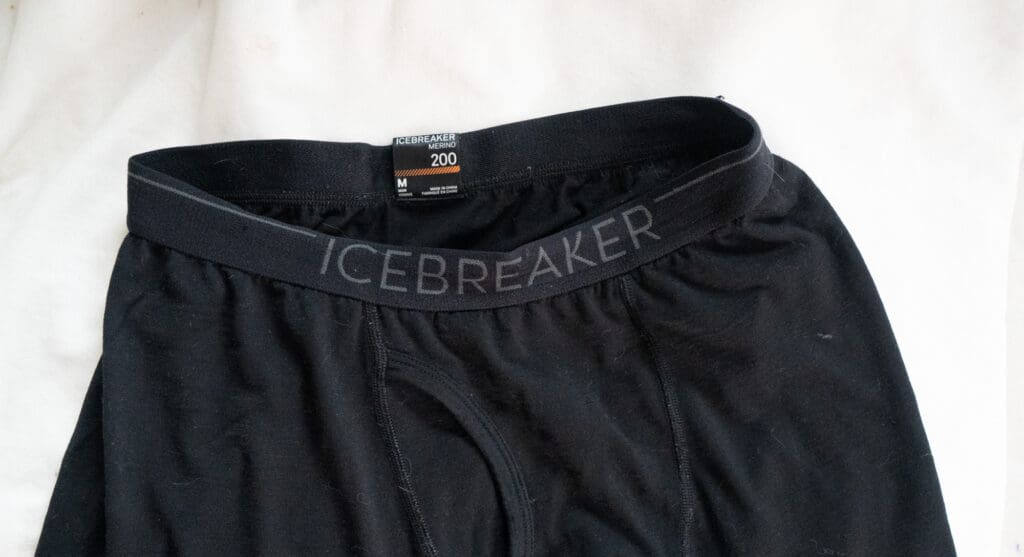
GSM (fabric weight): Grams per square metre. Your best single clue to warmth. See the table above.
Micron (fibre diameter): For wool, this tells you how fine each fibre is, measured in microns (thousandths of a millimetre). It’s the real answer to “why does one merino itch and another doesn’t.” According to the Woolmark Company, itch is a mechanical reaction to coarse fibres above roughly 30–32 microns, not a wool allergy, and superfine merino typically measures 17.5 microns or finer. Lower is softer. Not every brand publishes it, but the ones that do are worth noticing.
Knit structure: Jersey is flat and smooth, good under tight layers. Rib stretches and hugs. Grid or waffle knits create channels that trap warm air and vent moisture. Terry-loop or brushed backs add loft for warmth, like the terry zones on the Smartwool Intraknit.
Blend percentages: A few percent of elastane adds stretch and helps a layer hold its shape. Nylon adds abrasion resistance. A core-spun yarn (wool wrapped around a nylon core) gets you most of the softness of wool with more durability.
Certifications: For wool, certain animal-welfare standards like the Responsible Wool Standard (RWS) or ZQ, or a clear “non-mulesed” statement. For dyes and chemistry, bluesign® and OEKO-TEX® are the common ones. A certification won’t make a layer warmer, but it tells you something about how it was made. Companies won’t care if the consumer doesn’t, so demanding materials that are sourced with ethics and responsibility in mind will go a long way to repairing an industry with a terrible reputation.
Fit & Construction
A baselayer can only move moisture if it’s touching your skin, so it should fit snug without restricting movement. Beyond that, a few construction details are worth checking.
Flatlock seams: Flat seams that won’t rub under a pack strap or a harness.
Offset shoulder seams: Seams moved off the top of the shoulder so pack straps don’t sit on them.
Length: A longer back hem stays tucked in when you bend over to transition. Bottoms should end before the ankle, or higher if you have a tight-fitting boot with good insulation.
Zips, hoods, and thumb loops: A zip neck dumps heat on the skin track. A hood can replace a balaclava, like the one on the Airblaster Ninja Suit. Thumb loops keep sleeves from riding up under your gloves and midlayer.
Gusset and fly: A gusseted crotch on bottoms means more freedom to move and less seam wear.

Warranty & Longevity
A good baselayer costs real money, so it’s worth knowing what happens if it fails. Brand warranties fall into roughly three camps:
Satisfaction guarantees: The brand will make it right if you’re unhappy with the product, within a set time or for the product’s life. These are the most generous.
Defect warranties for a set period: Covers manufacturing faults like bad stitching or faulty fabric, for a fixed time from purchase. Wear and tear isn’t covered.
Defect warranties for the product’s “practical lifespan”: Covers manufacturing faults for as long as the item could reasonably be expected to last. That’s not the same as a lifetime warranty, and the brand decides what “reasonable” means.
Here’s where the brands in my roundup currently stand:
| Brand | Warranty | What it covers |
|---|---|---|
| Smartwool | Go Far. Feel Good.™ guarantee, two years from purchase | Any reason you’re not happy, within two years. Gear must be bought from Smartwool or an authorized dealer in Canada or the US. |
| Icebreaker | 1 year | Manufacturing faults in fabric or stitching. Proof of purchase required. |
| Mammut | 2-year quality guarantee | Material and production defects, not normal wear and tear |
| Arms of Andes | 15 days full refund | Manufacturing Defects |
| Airblaster | 1-year warranty | Manufacturing defects |
| Patagonia | Ironclad Guarantee | If it doesn’t perform, return it for repair, replacement, or refund. Damage from wear and tear is repaired at a reasonable charge. |
| PAKA | 30 days, no questions asked (not worn or washed) | Everything without question, as long as it isn’t worn or washed. Paka asks that you try it on over clothes if you are unsure of the fit. |
| Arc’teryx | Limited Warranty, “practical product lifespan” for apparel | Defects in materials and workmanship. Excludes normal wear and tear, rips and tears, and damage from incorrect laundering. Original purchaser, authorized dealer, proof of purchase. |
Warranty terms checked October 2026. They change, so confirm on the brand’s site before you buy.
There are few things almost no warranty covers. Holes worn through by use, snags, moth damage, and shrinkage from a hot dryer come to mind. Two habits help. Buy from an authorized dealer, because several brands won’t honour a warranty on marketplace or auction purchases. And keep your receipt, since most claims ask for proof of purchase. Even better, take a photo of it and file it away. It gets less of a pain in the ass the more it becomes a habit.
Care & Repair
The cheapest way to get a better baselayer is to make the one you have last longer.
Wash less: Wool and alpaca resist odour, so airing them out between days is often enough. Fewer washes means less wear.
Wash cool and gentle: Follow the care label. In general that means a cool, gentle cycle, a wool-safe detergent, and no fabric softener on wool.
Skip the dryer: Heat is the fastest way to shrink wool. Lay it flat or hang it to dry.
Catch the microfibres: If you wash synthetics, a microfibre-catching wash bag or a washing-machine filter traps some of the shed fibres before they reach the water.
Fix small holes early: A small hole in a knit spreads. A few stitches or a darning patch now saves the whole garment. Some brands also run repair programs. Patagonia sets the standard, Arc’teryx is catching up. Also, every community has a nice old lady willing to do it for a few bucks and an ear to hear her stories.
Really, it all comes down to being on top of it. You’ll need to wash your gear less if you give it time to air out between uses. Stashing it in a bag and leaving it in your car overnight will attract mold and become a stink pot. Merino and other wools win here always. Synthetics will eventually just start to smell bad, no matter how clean you think you can be.
Sustainability
Natural fibres are renewable and biodegradable, but they aren’t automatically ethical. For wool, the welfare questions are mulesing and land management, which is where certifications like RWS and ZQ come in. Synthetics are durable and often recycled, but they’re usually made from petroleum and shed microplastics in the wash.
The most sustainable baselayer is the one you already own, followed by one you’ll wear for a decade. Buy fewer, buy for how you actually ski, and look at resale programs like Patagonia’s Worn Wear and Arc’teryx’s ReBIRD before buying new.
Frequently Asked Questions
What does GSM mean on a baselayer?
GSM stands for grams per square metre, the weight of the fabric. Higher numbers usually mean warmer layers: roughly 150–200 for high-output days, 200–260 for all-round use, and 260 and up for cold, low-output days.
Why does merino wool itch some people?
Itch comes from coarse fibres pressing against the skin, not usually from an allergy. Merino’s fine fibres bend instead of prickling, and the finer the micron count, the softer it feels. If wool still bothers you, try alpaca or a plant-fibre blend.
Is a heavier baselayer always warmer?
Not always. Knit structure matters too: a grid or brushed fleece can trap more air than a heavier flat knit. And a heavy layer you sweat through can leave you colder than a lighter one that stays dry.
How many baselayers do I need for ski season?
For most people, two is plenty. A midweight for everyday use and either a lightweight for touring or a heavyweight for cold days. Start with one midweight and add the second once you know which way you lean. If you’re riding every day and in a wet climate, you might need more just to have time for it to air out. Same goes if you use synthetic clothing and need to wash them more often.
Do baselayer warranties cover holes?
Usually only if the hole comes from a manufacturing fault, like a seam that fails or fabric that tears early. Holes from normal wear, snags, or moths generally aren’t covered. A few brands, like Patagonia, will repair wear-and-tear damage for a reasonable charge, but keep in mind it won’t happen overnight.
The Final Word
Choosing a baselayer comes down to three questions: how hard will you work, how cold will it be, and how much do you sweat? Answer those, read the GSM and the fibre content, check what the warranty actually covers, and you’ll make a better call than most of the marketing will help you make.
When you’re ready to buy, the best baselayers roundup has eight picks I’ve tested, from lightweight touring layers to cold-day heavyweights.

Steve Andrews is a lifelong adventurer since before he could walk. A skier since age 2, snowboarder since 11, he began his guiding career in 2007. He has a passion for teaching people how to fish, and helping them discover their own power in the mountians. He started Alpine Islands to give people a different take on achieving mastery in the wild (hint: you’re never a master of Mother Nature). He lives in Horseshoe Bay, British Columbia with his partner and two kids.