Tested by
Steve Andrews
Where
Coast Mountains, BC
How long
One Month Days
Used for
Hiking in Atmospheric Rivers
Photos
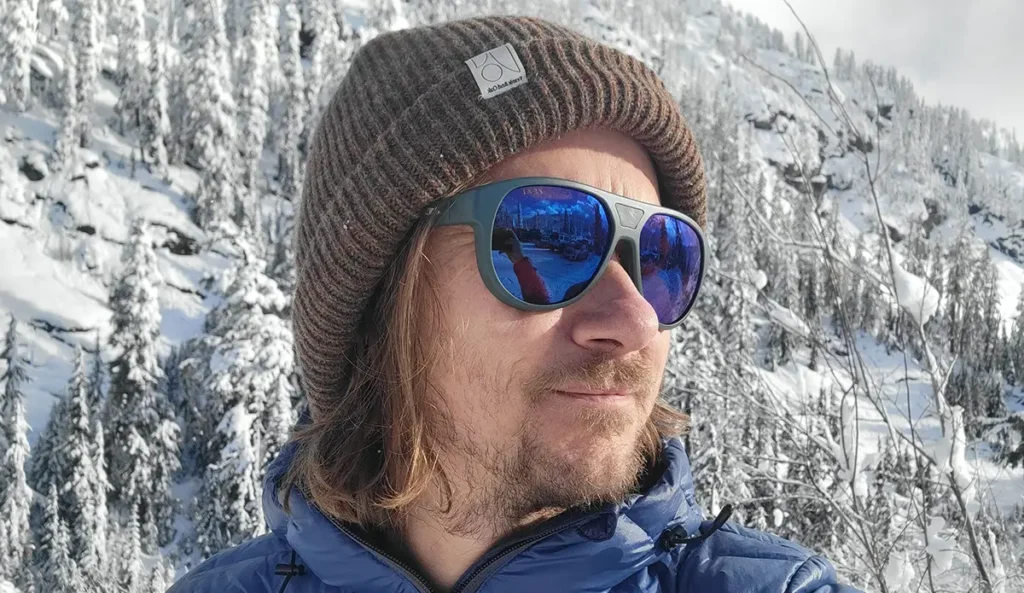
Steve Andrews and Lindsay Gough
In this review
Some links on this page are affiliate links. If you buy through them, Alpine Islands may earn a small commission at no extra cost to you. It never decides what I recommend or what I say about it. The verdicts here are mine, earned on snow.
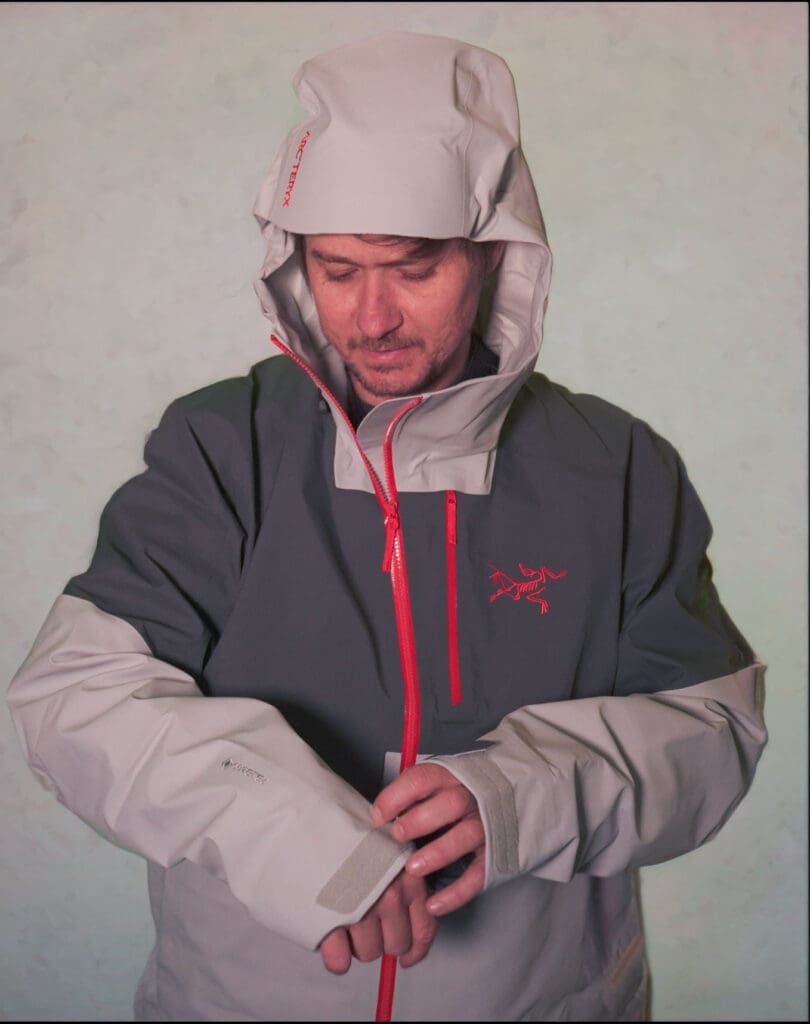
The Sidewinder has its zipper on the side rather than in the middle. That’s the big differentiator, but it’s always in the little details that sets something apart.
Arc’teryx first released the Sidewinder in 2001 as its first freeride shell, and for its 25th anniversary the jacket is back in the ski and snowboard line after an eight-year absence. The newly-updated 2026 version keeps the curved, offset zipper and changes almost everything else. The jacket now sports a new GORE-TEX ePE fabric, a relaxed fit, and a reworked pocket layout. I’ve just gotten a test sample and for now it’s been my atmospheric river hardshell. The snow hasn’t come yet, but for a stormproof outer layer, it’s pretty awesome.
Arc’teryx Sidewinder Jacket: First Impressions
A damn good jacket that lives up to the Arc’teryx reputation. The zipper to the side isn’t really enough to make me want to shell out a ton of money for the jacket. But it lives up to the legendary Arc’teryx reputation as a stormproof jacket that will keep you dry in the nastiest of conditions. The ample pockets means that you’ll have plenty to stash with you, but the weight makes this not the first choice for touring.
Notable Features of the Arc’teryx Sidewinder Jacket
The curved Sidewinder zipper: The centre-front zipper is thermomoulded into a curve that cups the collar in front of your chin, so it doesn’t chafe when you’re zipped all the way up. It’s been the jacket’s calling card since the original, and no other jacket does something similar.
Mapped GORE-TEX ePE shell: The body and hood are 100-denier, three-layer GORE-TEX ePE with a recycled nylon face, and the yoke and sleeves switch to a 100D ripstop face where a jacket takes the most abrasion. Both fabrics are made without intentionally added PFAS, which is a genuine step forward for a shell this burly. I’ve taken it out on 100mm rainstorm days and it’s held up as it should. It’s probably the thickest Gore-Tex jacket I’ve worn, especially one not using PFAS for waterproofing.
Pockets for everything: Lined side pockets make quick warmups to the hand, and a nice addition to have a goggle wipe on a leash in the right side pocket. In addition it has a chest pocket, a sleeve pass pocket, a flapped stash pocket, and two internal mesh dump pockets, one with a zippered pocket inside. I intentionally sized up here knowing that this was the type of jacket to stash extra gear in, and I was right. It’s got a ton of space and isn’t one for packing light.
A hood that works with or without a helmet: The hood cinch is nice and tight and allows for good movement with and without a helmet. The brim stays nice and taut even when the wind is blowing. With a good cinch all around, It stayed put even in the rainstorm without needing a helmet.
Two-way pit zips: Large vents that zip from both ends mean it is easy to use with a backpack on.
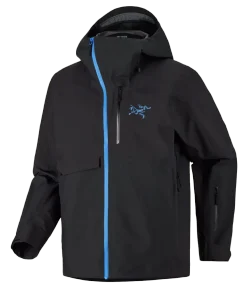
Arc’teryx Sidewinder Jacket (Men’s)
~$1,100 CAD / ~$850 USD
| Bottom line | A damn good, stormproof freeride shell with ample pockets, but the weight makes it not the first choice for touring. |
|---|---|
| Weight | 681 g / 1 lb 8 oz |
| Shell | 3L GORE-TEX ePE, 100D recycled nylon face (body and hood); 100D ripstop face (yoke and sleeves) |
| Fit | Relaxed I sized up to a Large and would have been fine with a M had I known how relaxed it was. |
| Pockets | 2 flapped hand, chest, sleeve pass, flapped stash, 2 internal mesh dump (one with zip pocket) |
| Venting | Pit zips, Zip from both ends |
| Hood | Helmet-compatible StormHood with brim, cinch in the back |
| Sizes | XS–XXL |
| Tested | Oct-Nov 2026, Coast Mountains, BC |
Worked
- Bombproof shell
- Ample pockets, including lined hand pockets
- Relaxed fit with room for a thick midlayer
- Tight hood cinch, with or without a helmet
- Two-way pit zips that work with a pack on
- Goggle wipe on a leash
Didn’t
- Bulky, rigid fabric with less give
- Heavy for touring
- Arms feel bulkier than other jackets
- The side zipper alone doesn’t justify the price
Specs verified November 2026 against manufacturer page.
Drawbacks
The material is definitely bulkier than most, and has less give than most of the other jackets I tested. It’s rigid. Some people may not mind it. I’m not saying that it is too heavy to move, but it’s certainly noticeable compared to something like the 7MESH Guardian Terra or a Pertex jacket like the Rab Bigline. Mammut’s Haldigrat with their proprietary material was also much softer and quieter.
The new Sidewinder weighs in at 681 g, about 90 g more than the 590 g it listed for the last version in 2019.
Best Uses for the Arc’teryx Sidewinder Jacket
I like sizing up a bit, but when I went up to a Large I found it to have just the right amount of oversize for stashing a lot of extra gear such as a first aid kit, camera supplies, a radio, and other guiding necessities. The average Joe or Jane probably doesn’t need it and wouldn’t need to size up since the relaxed fit allows for ample movement, in contrast to the Sabre jacket which I found a bit slim fitting. I don’t like things to fall off me, but I do appreciate a thick midlayer when it’s cold and this shell will be a saviour when it’s really cold and stormy, but also will keep gear dry when filming.
Skip If You…
You are a fair-weather skier. This is meant for stormy weather. It’s also not the best shell for touring, so if you’re primarily a backcountry skier or splitboarder there are other jackets that offer less rigidity.
Frequently Asked Questions
What’s the difference between the new Arc’teryx Sidewinder and the old one?
The 2026 Sidewinder keeps the curved offset zipper but swaps the old N80p-X GORE-TEX Pro for three-layer GORE-TEX ePE made without intentionally added PFAS, with ripstop in the yoke and sleeves. It moves to a relaxed fit, adds offset pockets, two internal dump pockets and a RECCO reflector, and weighs 681 g against the 2019 version’s listed 590 g.
What is the Arc’teryx Sidewinder best for?
This is a great jacket for resort freeriding or sidecountry, but not one to be doing much skinning in. Skinning could work, but there are many other lighter jackets out there if that’s how you spend the majority of your days.
Does the Arc’teryx Sidewinder run small?
Not at all, in fact it’s quite relaxed. Much more so than the Sabre, where I felt it fit quite close to the body. For that reason, I decided to size up and take advantage of the space to make it more of an expedition jacket for when the weather is really gnarly, as well as when I need to carry some extra bulk. But if you don’t like baggy, the sizing should be pretty roomy for your size. The arms are large and the jacket definitely feels longer than the Sabre.
Is the Arc’teryx Sidewinder worth it?
I wouldn’t buy it for the zipper placement on its own. The value for the money comes from a stormproof GORE-TEX shell with plenty of pockets, so it earns its price if you ride in awful weather, at the resort or in the sidecountry. If most of your days are on the skin track, a lighter shell would definitely be a better call.
Final Thoughts
The Sidewinder is back, and a go-to when it’s nasty out. The curved zipper is a nice touch, but it isn’t the reason to buy it. The reasons are a shell that keeps the weather out, pockets for everything, and a fit with room for a real midlayer. If your days are mostly uphill, Check out something lighter.
This is also a jacket fine-tuned to freeride skiing or snowboarding. If you are looking for something from Arc’teryx that is a bit more versatile, more sustainable in its circular design (however more expensive as a result), it might be worth checking out the Sperro SV.
For something lighter and more packable on long skin tracks, try the 7MESH Guardian Terra. For something softer and quieter with big chest pockets, try the Mammut Haldigrat. And to see how they all stack up, read my roundup of the best hardshell jackets for backcountry skiing and splitboarding.

Steve Andrews is a lifelong adventurer since before he could walk. A skier since age 2, snowboarder since 11, he began his guiding career in 2007. He has a passion for teaching people how to fish, and helping them discover their own power in the mountians. He started Alpine Islands to give people a different take on achieving mastery in the wild (hint: you’re never a master of Mother Nature). He lives in Horseshoe Bay, British Columbia with his partner and two kids.